Hydrogen Vehicle Market Accelerating the Race Toward Zero-Emission Mobility
Introduction
The transportation sector accounts for roughly 24% of global CO₂ emissions - making its decarbonization one of the most urgent challenges of our time. While battery electric vehicles (BEVs) dominate headlines, hydrogen fuel cell vehicles (FCEVs) are carving out a critical role in the zero-emission mobility ecosystem - particularly for long-haul transport, heavy-duty vehicles, and applications where battery weight and charging time are prohibitive. The Hydrogen Vehicle Market is accelerating, backed by government mandates, falling fuel cell costs, and expanding refueling infrastructure.
How Hydrogen Vehicles Work
Fuel cell electric vehicles (FCEVs) generate electricity from hydrogen through a chemical reaction with oxygen in a fuel cell stack. The only byproduct is water vapor. Unlike battery EVs that store energy, FCEVs generate it on demand - offering:
- Longer range (typically 400–700+ km per fill)
- Faster refueling (3–5 minutes, similar to gasoline)
- High energy density - critical for heavy-duty applications
Market Overview and Growth
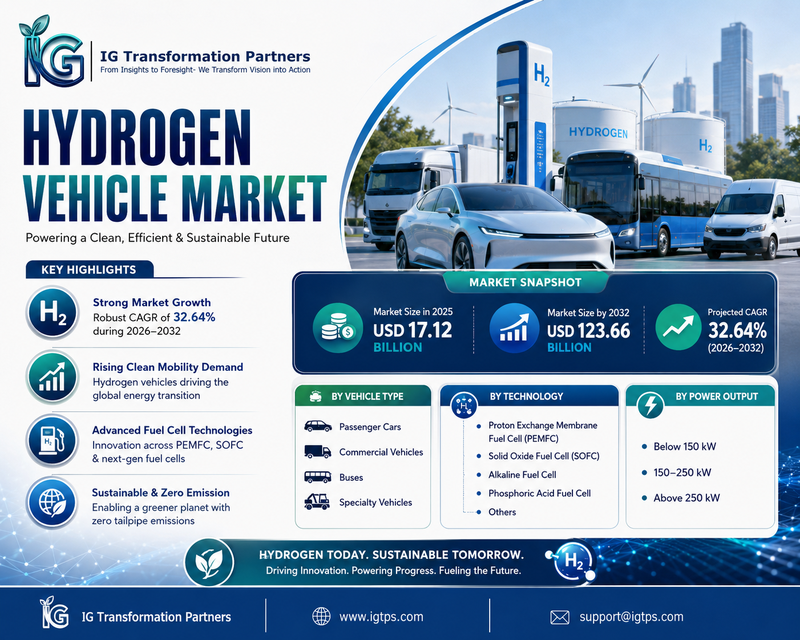
The global hydrogen vehicle market was valued at approximately USD 2.1 billion in 2023 and is projected to reach USD 48 billion by 2031, growing at an astonishing CAGR of 47.8%. This rapid growth reflects:
- Government hydrogen mobility strategies in South Korea, Japan, Germany, China, and the U.S.
- The EU's mandate to eliminate combustion engine truck sales by 2040
- Growing commercial adoption in bus fleets, port logistics, and long-haul trucking
- Rapidly declining fuel cell system costs - down over 60% in the last decade
Key Vehicle Segments
- Passenger cars - Toyota Mirai and Hyundai NEXO lead the segment
- Commercial trucks - Nikola, Hyundai, and Daimler Truck are key players
- Buses and transit - Several cities globally have deployed hydrogen bus fleets
- Rail - Hydrogen trains are operational in Germany and being piloted widely
- Marine shipping - Among the hardest-to-electrify sectors; hydrogen and ammonia are primary decarbonization options
IG Transformation Partners: Competitive Intelligence for the Hydrogen Economy
Navigating the hydrogen vehicle market requires understanding technology trajectories, OEM strategies, infrastructure investment patterns, and policy environments simultaneously. IG Transformation Partners provides the strategic intelligence that automotive companies, energy providers, and investors need to build winning positions in the hydrogen mobility value chain.
Infrastructure: The Critical Bottleneck
The "chicken and egg" problem persists: limited refueling stations deter FCEV adoption; limited vehicles deter station investment. However, this is beginning to change:
- Japan has over 160 hydrogen refueling stations (HRS) and is expanding rapidly
- South Korea is targeting 1,200 HRS by 2030
- California has the most HRS in the U.S. with continued expansion planned
- Europe's H2 Mobility initiative is building a pan-continental refueling corridor
Challenges
- Green hydrogen cost - Most hydrogen today is still grey; green hydrogen must reach price parity
- Infrastructure gaps - HRS density is still too low for mainstream consumer adoption
- Technology maturity - Fuel cell durability and cold-weather performance continue to improve but need further development
- Competition from BEVs - Battery vehicles have a massive head start in passenger car adoption
Future Outlook
FCEVs will likely coexist with BEVs rather than replace them - dominating in heavy-duty, long-range, and commercially intensive applications. By 2035, hydrogen trucks could be cost-competitive with diesel in many markets.
Conclusion
The hydrogen vehicle market is no longer a concept - it's a commercial reality gaining meaningful momentum in both personal and commercial transport. Early movers in fuel cell technology, green hydrogen production, and refueling infrastructure are positioning themselves for extraordinary returns as the market matures.
📊 Dive deep into the Hydrogen Vehicle Market Report for OEM strategies, infrastructure investment trends, and 10-year market forecasts.
FAQs
Q1. How do hydrogen fuel cell vehicles differ from battery electric vehicles? FCEVs generate electricity on board from hydrogen using a fuel cell; BEVs store electricity in batteries. FCEVs offer faster refueling and better range but require hydrogen infrastructure.
Q2. Are hydrogen vehicles safe? Yes. Hydrogen tanks are designed to be safer than gasoline tanks, with rigorous pressure testing and multiple safety systems. FCEVs have strong safety records.
Q3. How far can hydrogen vehicles travel on one tank? Most current FCEVs offer a range of 400–700 km per fill, comparable to or exceeding many gasoline vehicles.
Q4. How long does it take to refuel a hydrogen vehicle? Approximately 3–5 minutes - similar to conventional gasoline refueling.
Q5. What is the main barrier to hydrogen vehicle adoption? The limited number of hydrogen refueling stations is the primary barrier to mainstream consumer adoption.
Q6. Which companies lead the hydrogen vehicle market? Toyota, Hyundai, Honda, Daimler Truck, Nikola, and Ballard Power Systems are among the leading players.
Q7. Will hydrogen or electric vehicles win the transportation future? Both will coexist. BEVs are better suited for passenger cars and short-range applications; FCEVs offer advantages in heavy-duty, long-haul, and commercially intensive transport.