Decentralized Identity Market: Redefining Trust in a Digital-First World
Introduction
In today's digital economy, identity is everything. Yet our current systems for managing digital identity are fragmented, insecure, and disempowering. Individuals hand over vast amounts of personal data to corporations and governments, with little control over how it's used. Data breaches expose billions of records annually. The Decentralized Identity Market offers a radically different vision - one where individuals own and control their digital identities, and where trust is established through cryptography rather than central authorities.
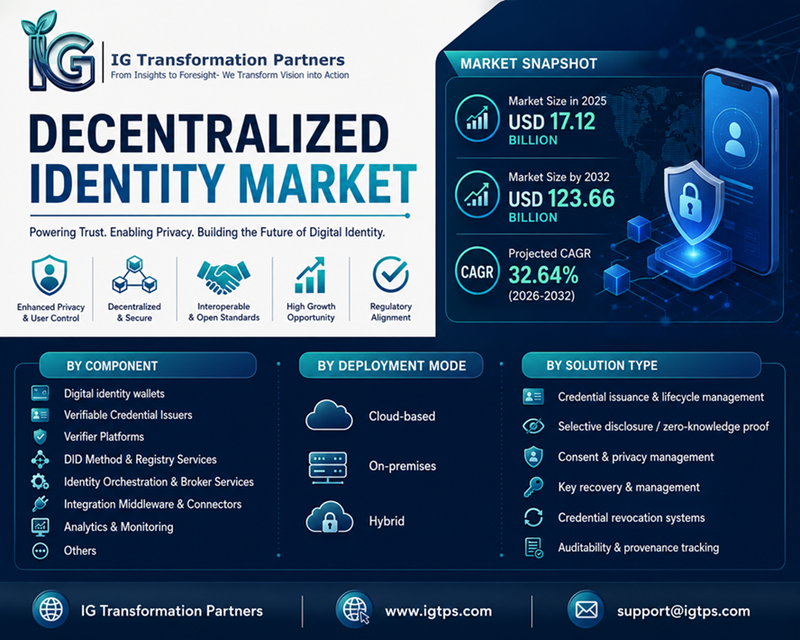
What Is Decentralized Identity?
Decentralized identity (DID) is a framework that gives individuals control over their own digital identities without relying on a central issuing authority like Google, Facebook, or a government database. Using blockchain technology, verifiable credentials, and cryptographic proofs, users can:
- Create and manage their own identity credentials
- Selectively share only necessary information
- Revoke access at any time
- Interact with any service that accepts the standard
Think of it as a digital version of a physical wallet: you hold your own ID card, passport, and loyalty cards - you show only what's needed, to whom you choose.
Market Size and Growth
The global decentralized identity market was valued at approximately USD 1.1 billion in 2023 and is expected to grow at an extraordinary CAGR of 88.7% through 2030 - one of the fastest growth rates in technology. Several converging forces are driving this explosive trajectory:
- Rising global cybersecurity threats and data breaches
- Regulatory mandates like GDPR and emerging digital identity frameworks
- Enterprise demand for privacy-preserving authentication
- The growth of Web3 ecosystems and blockchain platforms
- Government digital ID initiatives (EU's eIDAS 2.0 is a landmark example)
Key Technology Components
- Decentralized Identifiers (DIDs) - unique identifiers stored on blockchains, not controlled by any company
- Verifiable Credentials (VCs) - digital equivalents of physical credentials, cryptographically signed
- Blockchain/Distributed Ledger Technology - provides the immutable, decentralized trust layer
- Zero-Knowledge Proofs - allow users to prove a fact (e.g., "I am over 18") without revealing underlying data
IG Transformation Partners: Intelligence for Identity Innovation
For technology companies, financial institutions, and governments navigating the complex intersection of identity, privacy, and regulation, IG Transformation Partners delivers strategic market analysis that supports product roadmap decisions, partnership strategies, and compliance positioning in the decentralized identity ecosystem.
Real-World Applications
- Financial Services (KYC/AML) - Streamlining customer onboarding while reducing fraud
- Healthcare - Patients control and share their medical records selectively
- Education - Verifiable academic credentials that can't be forged
- Travel and Border Control - Digital passports and immigration credentials
- Employment - Portable professional credentials verified without third parties
Challenges
- Interoperability - Multiple competing standards and platforms must align for widespread adoption
- Key management - If a user loses their private key, they lose access to their identity
- Regulatory alignment - Governments and regulators are still developing frameworks to accommodate DIDs
- User experience - Complexity must be abstracted for mainstream adoption
Future Outlook
The decentralized identity market is poised to fundamentally reshape digital trust infrastructure. The EU's digital wallet mandate, the adoption of W3C DID standards, and growing enterprise interest in privacy-preserving identity solutions will drive mainstream adoption through the decade.
Conclusion
Decentralized identity is not just a technical innovation - it's a philosophical shift in the relationship between individuals, institutions, and data. For companies building in this space, the opportunity to establish foundational infrastructure for the digital economy is profound.
📊 Access the complete Decentralized Identity Market Report for technology benchmarks, use case analysis, and growth forecasts.
FAQs
Q1. What is decentralized identity? It is a model where individuals control their own digital identity credentials without relying on centralized authorities, using blockchain and cryptography.
Q2. How does decentralized identity improve privacy? Users can share only the minimum data required for a transaction, verified via cryptographic proofs without exposing underlying personal information.
Q3. What blockchain networks support decentralized identity? Ethereum, Hyperledger Indy, Sovrin, Microsoft ION, and others support DID standards.
Q4. Is decentralized identity regulated? Regulation is evolving. The EU's eIDAS 2.0 framework is a leading example of government-level DID adoption and legal recognition.
Q5. Who are the leading players in the decentralized identity market? Key players include Microsoft, IBM, Ping Identity, Evernym, Civic Technologies, and uPort.
Q6. What is a verifiable credential? A verifiable credential is a digital, cryptographically signed document that proves a claim (e.g., age, degree, license) - analogous to a physical certificate.
Q7. What is a zero-knowledge proof in identity? A ZKP allows someone to prove they meet a condition (e.g., "I am over 21") without revealing the actual underlying data (e.g., date of birth).
Online Pharmacy Market: How Digital Health Is Transforming the Way We Access Medicine
Introduction
Imagine renewing a prescription without leaving your home, comparing drug prices across dozens of pharmacies in seconds, or receiving chronic medication on a monthly auto-delivery schedule. This is the reality of the modern Online Pharmacy Market - and it's growing at a pace that's reshaping the entire pharmaceutical retail landscape.
The convergence of telemedicine, e-commerce, and digital health platforms has created a powerful new channel for medication access that is both more convenient and, increasingly, more personalized than traditional brick-and-mortar pharmacies.
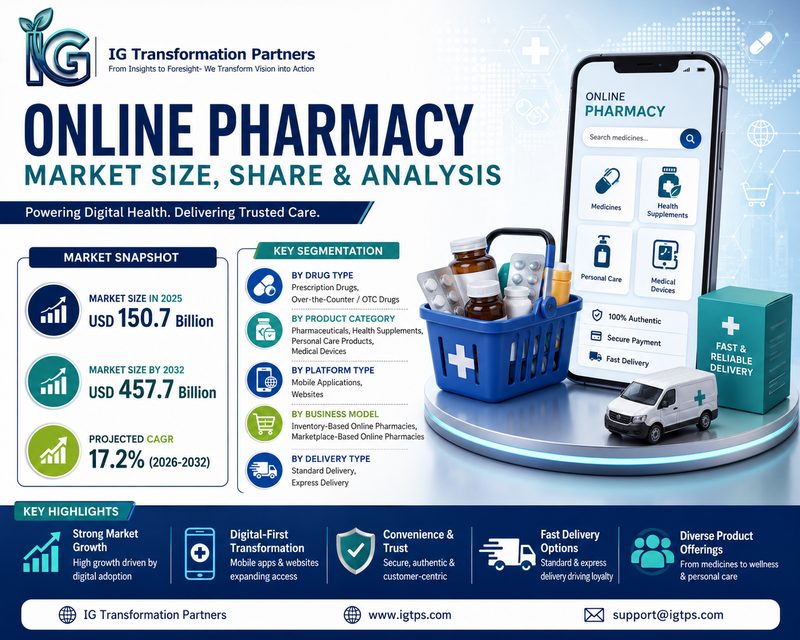
Market Overview
The global online pharmacy market was valued at approximately USD 98 billion in 2023 and is projected to surpass USD 310 billion by 2031, growing at an impressive CAGR of 15.3%. This growth is being driven by a combination of structural shifts in healthcare delivery and fundamental changes in consumer behavior.
Key Growth Drivers
The Telemedicine Revolution
Online pharmacies and telehealth platforms are increasingly integrated. A patient consults a doctor digitally, receives a digital prescription, and has medication delivered within 24–48 hours - all without stepping outside.
Aging Population
Older adults with chronic conditions benefit enormously from home delivery of medications, reducing the burden of frequent pharmacy visits.
COVID-19 Acceleration
The pandemic accelerated online pharmacy adoption by years. Consumers who discovered the convenience during lockdowns have largely maintained the habit.
Smartphone and Internet Penetration
Expanding digital access in Asia, Latin America, and Africa is opening enormous new markets for online pharmaceutical retail.
Chronic Disease Management
Patients managing diabetes, hypertension, and other chronic conditions find subscription-based medication delivery highly practical and cost-saving.
IG Transformation Partners: Navigating Digital Healthcare Markets
The online pharmacy sector intersects healthcare regulation, e-commerce logistics, and digital health technology in complex ways. IG Transformation Partners equips pharmaceutical companies, retailers, and investors with the market intelligence needed to navigate entry strategies, compliance requirements, and competitive positioning in this high-growth segment.
Key Challenges
- Regulatory complexity - Online pharmacy licensing and prescription verification laws vary significantly by country and even by state/province
- Counterfeit drug risks - Fraudulent online pharmacies remain a serious consumer safety concern
- Cold chain logistics - Certain medications require temperature-controlled delivery, complicating last-mile fulfillment
- Patient data privacy - Handling sensitive health and prescription data demands robust cybersecurity
Emerging Trends
- AI-powered drug interaction checking integrated into pharmacy apps
- Telepharmacy consultations with licensed pharmacists via video
- Personalized medicine and compounded medication delivery
- Same-day delivery powered by micro-fulfillment centers in urban areas
- Subscription wellness bundles combining OTC products, supplements, and prescription medications
Future Outlook
The next decade will see online pharmacies become fully integrated into digital health ecosystems - connected to electronic health records, wearables, and AI diagnostic tools. The line between pharmacy, telehealth provider, and health coach will blur significantly.
Conclusion
The online pharmacy market represents one of healthcare's most dynamic and impactful growth stories. For businesses at the intersection of technology and pharmaceutical care, the opportunity to build patient trust, improve access, and drive sustainable growth is immense.
📊 Explore the full Online Pharmacy Market Report for market sizing, competitive analysis, and strategic insights.
FAQs
Q1. Is it safe to buy medication from an online pharmacy? Yes, when using a licensed, verified online pharmacy. Look for regulatory approval seals and avoid sites that sell prescription drugs without requiring a prescription.
Q2. How do online pharmacies verify prescriptions? Legitimate online pharmacies require a valid prescription from a licensed healthcare provider, often verified digitally through integrated telehealth platforms.
Q3. Can all medications be purchased online? Most over-the-counter and many prescription medications can be purchased online, though controlled substances have stricter regulations and may not be available digitally.
Q4. How fast is online pharmacy delivery? Delivery times range from same-day (in some urban markets) to 1–5 business days depending on the provider and location.
Q5. Which region leads the online pharmacy market? North America and Europe currently lead, though Asia-Pacific is the fastest-growing region, driven by China and India's massive digital health expansion.
Q6. How are online pharmacies regulated? Regulations vary by country. In the U.S., online pharmacies must be licensed by state boards of pharmacy and ideally NABP-accredited.
Q7. What are the cost benefits of online pharmacies? Online pharmacies often offer lower prices than brick-and-mortar stores due to reduced overhead, along with generic drug options and price comparison tools.
Hydrogen Energy Storage Market: The Key to Unlocking a Clean Energy Future
Introduction
The global energy system has a fundamental challenge: renewable energy is intermittent. The sun doesn't always shine. The wind doesn't always blow. To build a reliable clean energy grid, we need a way to store large quantities of energy over extended periods - and hydrogen is emerging as one of the most promising answers. The Hydrogen Energy Storage Market sits at the heart of the energy transition, offering a scalable solution to the storage challenge that batteries alone cannot solve.
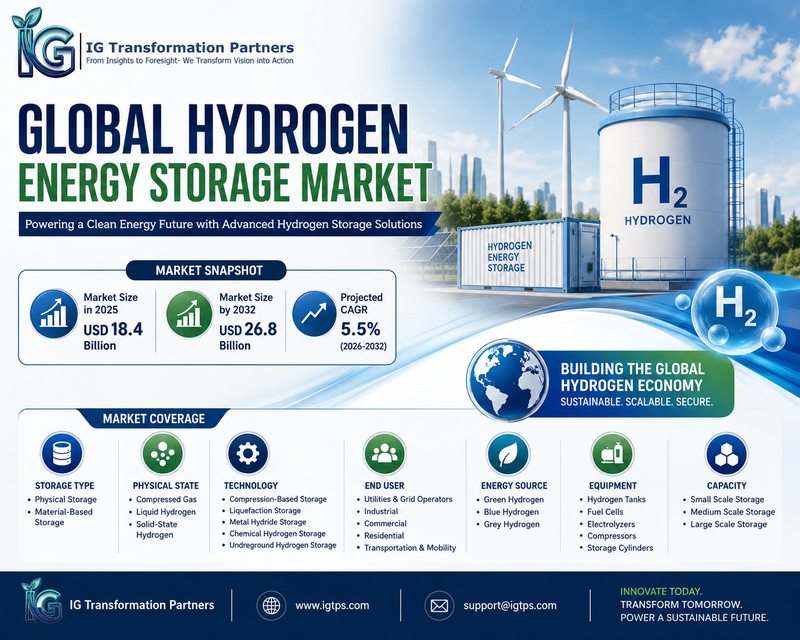
How Hydrogen Energy Storage Works
Hydrogen energy storage involves converting surplus electricity (ideally from renewables) into hydrogen gas via electrolysis - splitting water into hydrogen and oxygen. The hydrogen is then stored and later converted back to electricity via fuel cells, or used directly as fuel in industrial processes, transport, or heating.
Key components of the hydrogen storage ecosystem:
- Electrolyzers - convert electricity to hydrogen
- Storage systems - compressed gas tanks, liquid hydrogen vessels, or solid-state storage materials
- Fuel cells - convert stored hydrogen back to electricity
- Pipeline and transport infrastructure - move hydrogen to point of use
This flexibility makes hydrogen uniquely versatile compared to lithium-ion batteries, which are better suited for short-duration storage.
Market Size and Growth
The global hydrogen energy storage market was valued at USD 14.5 billion in 2023 and is expected to grow at a remarkable CAGR of 9.8% through 2032. Investment is surging from governments, energy majors, and clean tech companies worldwide.
Key growth drivers include:
- National hydrogen strategies - The EU, U.S., Japan, South Korea, Australia, and India have all launched government-backed hydrogen programs with billions in funding commitments
- Decarbonization of hard-to-abate sectors - Steel, cement, chemicals, and shipping are turning to hydrogen as their decarbonization pathway
- Grid-scale energy storage demand - As renewable penetration increases, long-duration storage becomes critical
- Falling electrolyzer costs - Green hydrogen costs are dropping rapidly as electrolyzer technology matures and scales
Types of Hydrogen by Production Method
- Green hydrogen - produced from renewable electricity via electrolysis (carbon-free)
- Blue hydrogen - produced from natural gas with carbon capture and storage
- Grey hydrogen - conventional production without carbon capture (most current supply)
Green hydrogen is the ultimate goal, and its cost trajectory is becoming increasingly competitive.
IG Transformation Partners: Mapping the Hydrogen Opportunity
The hydrogen economy spans multiple value chain segments - from production to storage to end use. IG Transformation Partners helps energy companies, industrial conglomerates, and government agencies understand where the highest-value opportunities lie, what competitive moats are forming, and how policy dynamics are shaping the market.
Challenges Facing the Market
- Green hydrogen remains expensive - current production costs are higher than fossil fuel alternatives, though costs are falling
- Storage and transport infrastructure - hydrogen requires significant infrastructure that is still being built
- Energy efficiency losses - the round-trip efficiency of hydrogen storage is lower than batteries, making economics challenging for short-duration applications
- Safety considerations - hydrogen's flammability requires specialized handling and strict safety protocols
Future Trends
- Offshore wind + electrolysis combinations will emerge as major green hydrogen production hubs
- Liquid organic hydrogen carriers (LOHCs) will enable cost-effective long-distance hydrogen transport
- Underground geological storage will provide massive-scale seasonal storage capacity
- Hydrogen valleys - regional hydrogen ecosystems - are forming in Europe, Japan, and Australia
- Ammonia as a hydrogen carrier is gaining traction for maritime shipping and export
Conclusion
Hydrogen energy storage is not a distant dream - it is an industry being built right now, with trillions of dollars in investment and political will behind it. The companies and governments that move early to establish positions in production, storage, and delivery infrastructure will shape the energy landscape for generations.
📊 Access the full Hydrogen Energy Storage Market Report for comprehensive analysis, technology benchmarks, and investment insights.
FAQs
Q1. What is hydrogen energy storage? It is the process of using surplus electricity to produce hydrogen via electrolysis, storing it, and converting it back to energy when needed.
Q2. Why is hydrogen important for renewable energy? Hydrogen solves the intermittency problem of renewables by storing large amounts of energy over long periods - something batteries cannot do cost-effectively at scale.
Q3. What is green hydrogen? Green hydrogen is produced from water using renewable electricity and electrolysis, resulting in zero carbon emissions.
Q4. How is hydrogen stored? Common storage methods include compressed gas tanks, cryogenic liquid hydrogen, and solid-state materials like metal hydrides.
Q5. Is hydrogen energy storage commercially viable today? Partially. Blue and grey hydrogen storage are commercially active; green hydrogen costs are declining and expected to reach parity with fossil alternatives in several markets by 2030.
Q6. Which sectors will benefit most from hydrogen storage? Heavy industry (steel, chemicals), transportation (shipping, aviation), and grid-scale power storage are the primary beneficiaries.
Q7. What countries are leading in hydrogen energy investment? Germany, Japan, South Korea, the United States, Australia, and Saudi Arabia are among the top investors in hydrogen infrastructure and technology.